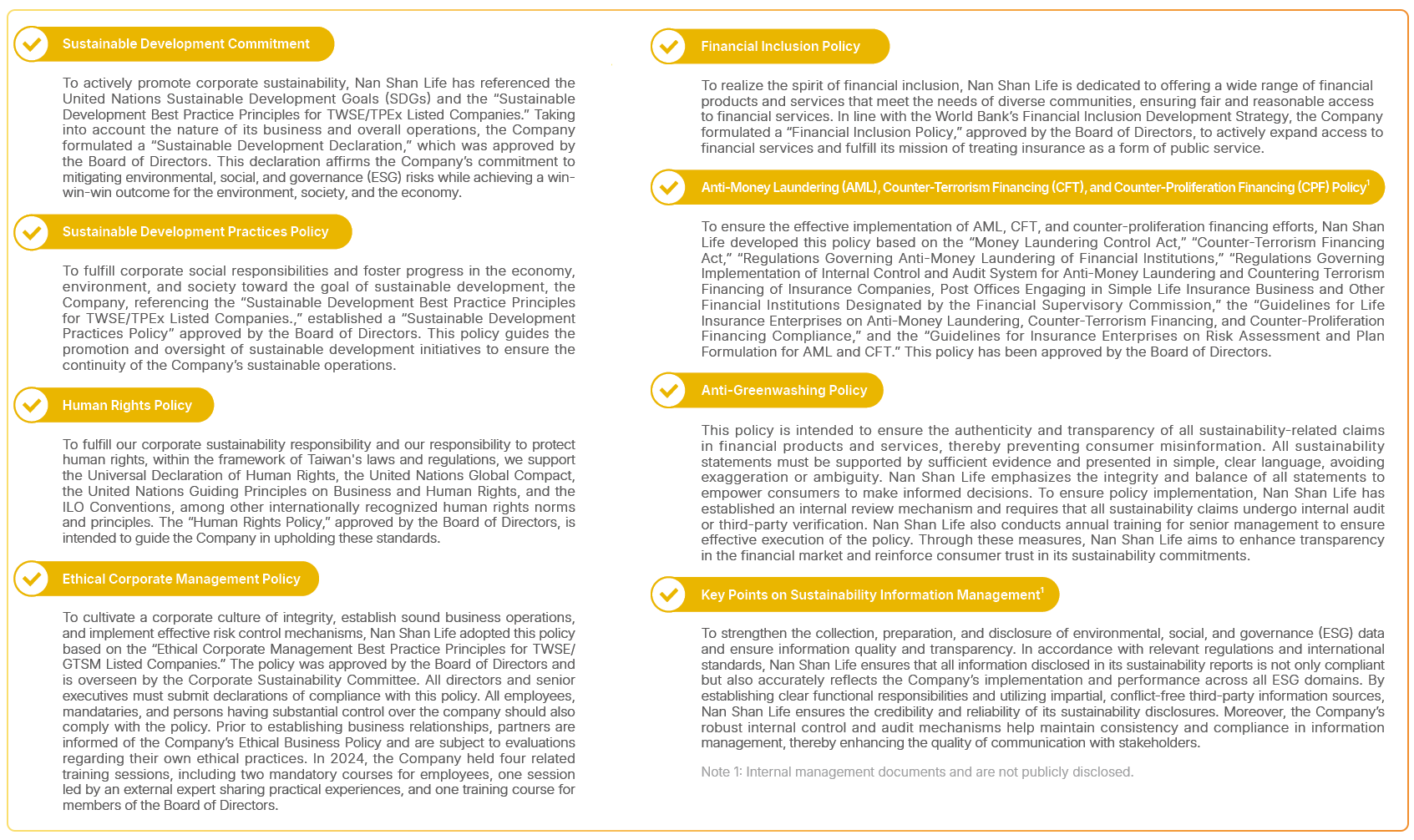
To fulfill its corporate social responsibility and uphold ethical business practices while safeguarding the interests of all stakeholders, Nan Shan Life has established a set of policies and commitments for responsible business conduct. These serve as a solid foundation for corporate governance and are continually updated in accordance with the evolving regulatory landscape, both domestic and international.
Commitment to Responsible Business Conduct
High-Standard Culture of Corporate Integrity
Anti-Trust and Anti-Competitive Practices
Nan Shan Life has included provisions on anti-trust and anti-competitive behavior in its Code of Conduct for Employees. In the event of any rumor or investigation by competent authorities regarding potential violations of the Fair Trade Act or other relevant laws, the Company will immediately report the matter to the line manager, the Chief Compliance Officer at headquarters, and the President, and take prompt responsive or remedial actions. In 2024, Nan Shan Life recorded no incidents involving violations of the Fair Trade Act or other relevant regulations.
Anti-Money Laundering (AML), Counter-Terrorism Financing (CFT), and Counter-Proliferation Financing (CPF)
Nan Shan Life is committed to assisting in the prevention of money laundering, terrorism financing, and proliferation financing (hereinafter referred to as “AML and CFT). The Company has established a dedicated AML unit and formulated relevant management policies and internal operational guidelines to effectively promote, supervise, and monitor its AML and CFT efforts.
Intellectual Property Protection and Management
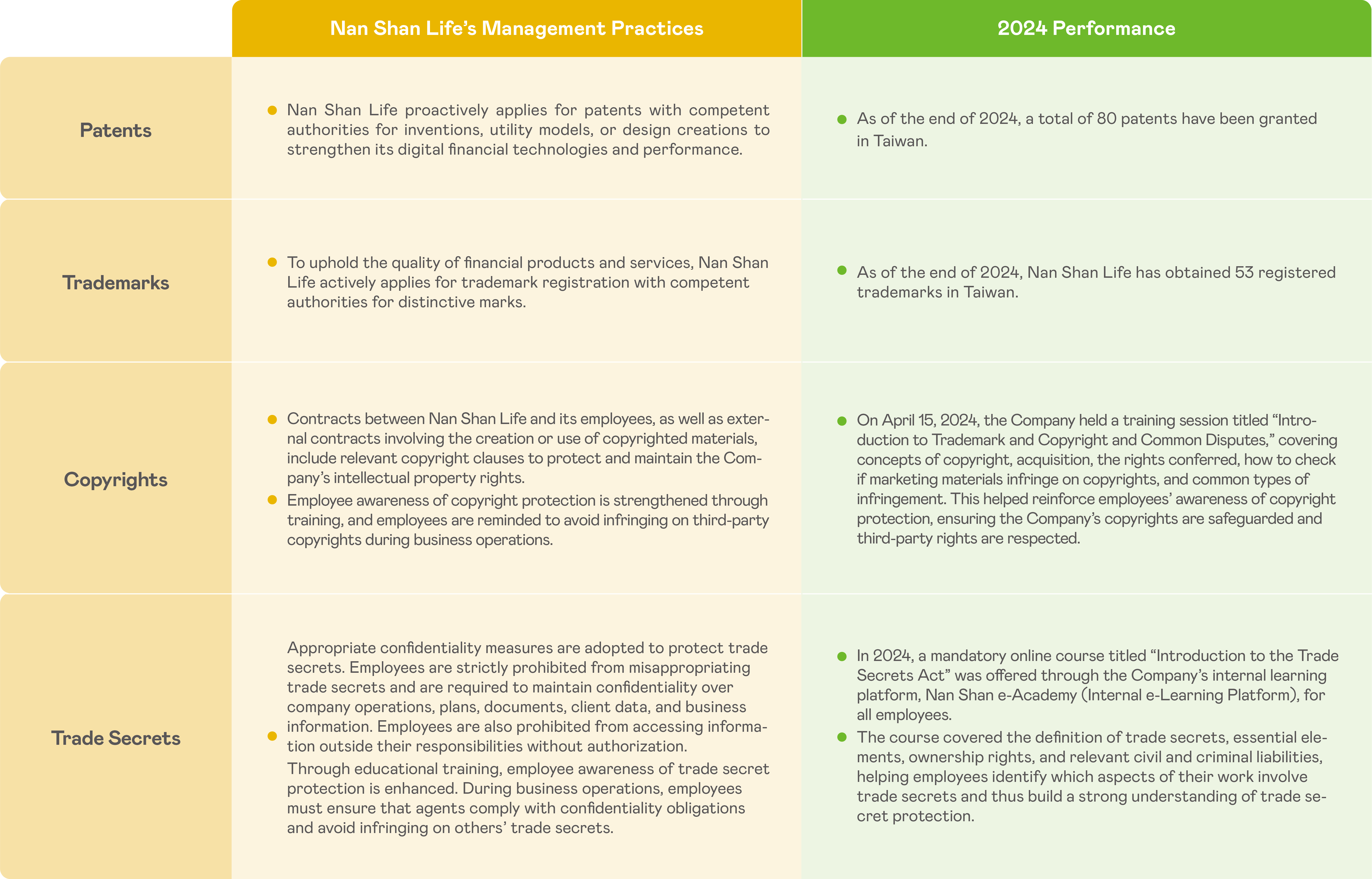
Nan Shan Life has adopted the Intellectual Property Management Regulations based on the Corporate Governance Best-Practice Principles for TWSE/TPEx Listed Companies and the Industrial Development Bureau’s Taiwan Intellectual Property Management System (TIPS). These regulations cover comprehensive measures for acquiring, protecting, maintaining, and utilizing intellectual property such as patents, trademarks, copyrights, and trade secrets. The implementation of these regulations is also incorporated into the internal audit process to ensure that the Company can effectively create, protect, and manage intellectual property while driving digital financial innovation, thereby enhancing its competitiveness in the financial market.
Employee Code of Conduct
Nan Shan Life has established an Employee Code of Conduct that defines responsibilities and obligations, and sets standards for compliance with applicable laws, regulations, and internal policies in the course of work. To ensure employees understand and implement the Code of Conduct, Nan Shan Life provides annual training for all administrative employees. In 2024, a total of 4,275 administrative employees completed the training course on the Code of Conduct, accounting for approximately 99% of all employees. No incidents of corruption were reported during the year.
Compliance
To ensure that administrative employees and agents fully understand and internalize the Company’s principles of ethical business conduct and legal knowledge, Nan Shan Life continues to provide comprehensive and enriched compliance training through both physical and digital channels. In 2024, legal compliance courses were offered separately for administrative employees and agents. In terms of participation, a total of 49,174 course completions were recorded for employees, and 40,738 for agents.
Ethical Corporate Management Mechanism
Nan Shan Life strictly complies with applicable laws and regulations and has implemented robust internal audit and control systems as well as related management measures. The Company’s “Regulations on Handling of Whistleblowing Cases” clearly define the processes for case acceptance, internal reporting, and investigation. Any person who discovers potential criminal acts, fraud, or legal violations committed by administrative employees, managers, or directors in the course of their duties may report such incidents to the Compliance Department through the following channels.
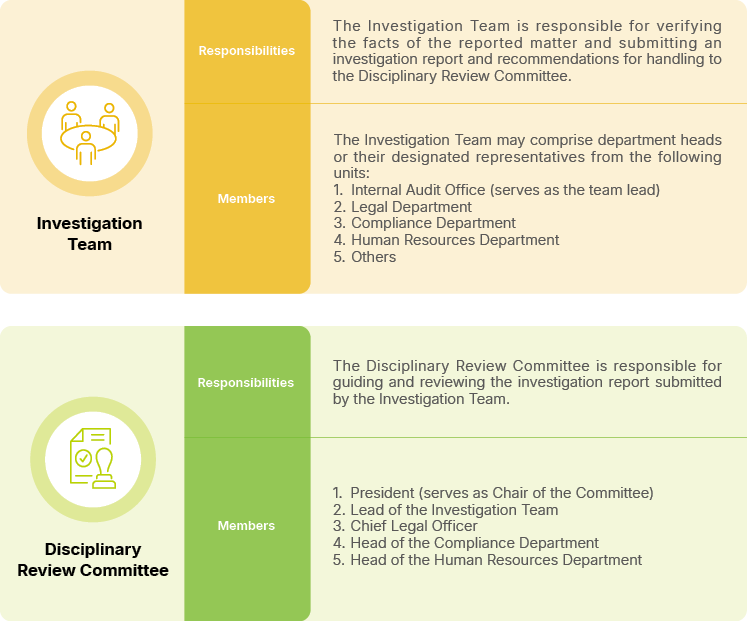
If the content of a whistleblower report is specific, clearly stated, and supported by sufficient evidence, the case may be accepted for investigation even if the report is submitted anonymously. If the receiving unit deems the report admissible, an Investigation Team will be responsible for conducting the investigation, while the Disciplinary Review Committee will review the investigation report. If the subject of the report is a director or a senior executive at the level of Vice President or above, the case must undergo further review by the Audit Committee. If the report falls outside the scope of whistleblower matters, the receiving unit shall assess whether other appropriate procedures should be taken and refer the case to the responsible unit for handling.