Nature and Biodiversity Information Disclosure
At the 2020 UN Biodiversity Conference, the Kunming-Montreal Global Biodiversity Framework was adopted, emphasizing the critical role of capital markets in biodiversity conservation and sustainable development. To understand the impact of its value chain on nature and biodiversity, Nan Shan Life adopted the LEAP approach recommended by the Taskforce on Nature-related Financial Disclosures (TNFD) and conducted biodiversity impact assessments across 82 global operational sites. These were further analyzed as Taiwan-based and global sites. This analysis defined a buffer zone around each operational site to represent its potential impact area, which was then overlaid with local protected area mapping to further identify and summarize the potential impacts of site operations on biodiversity.
Biodiversity Impact Analysis
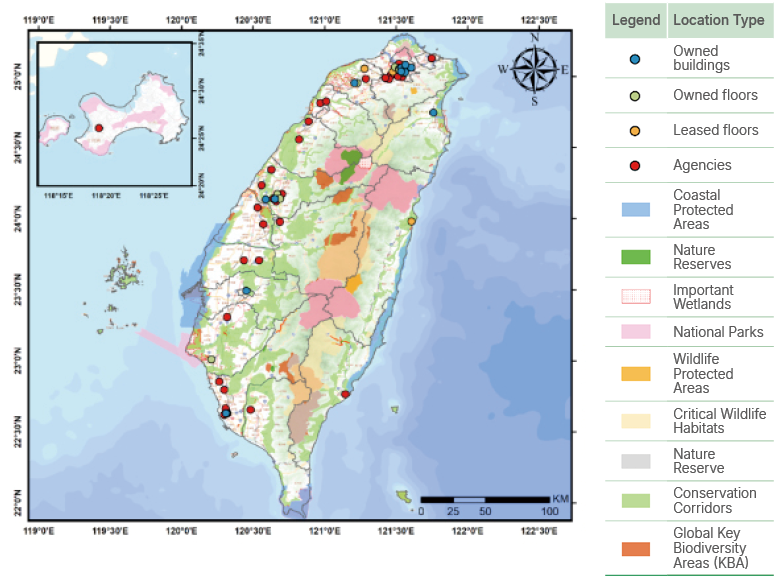
The results of the biodiversity impact assessment revealed that 15 operational sites intersect with areas regulated by law or included in the IUCN’s global protected area database. In addition, 23 sites intersect with conservation corridors not covered by formal regulations. The operational sites in Shanghai and Vietnam were not located within any protected area boundaries.
Nan Shan Life Insurance – Taiwan Locations
Cultural and Natural Conservation Area Analysis
Nan Shan Life conducted an assessment of its global operations in relation to Key Biodiversity Areas (KBAs), Ramsar Wetlands, UNESCO World Cultural Heritage Sites, and the Man and the Biosphere Programme to evaluate the distribution of its business activities. The analysis found that seven sites in Taiwan fall within KBAs, while one overseas location lies within a designated World Cultural Heritage Site.
Nature Dependency and Impact Analysis
Nan Shan Life employed a self-assessment questionnaire to evaluate the degree of dependency and impact its operating locations have on natural capital. This approach identified the level of exposure and risk associated with each ecosystem, where exposure refers to the degree of vulnerability to a given issue, and risk indicates the potential impact on the Company. These assessments enable the Company to identify nature-related risks more effectively and inform the development of environmental sustainability strategies.
Nan Shan Life continues to monitor and assess the ecological impact of its operational sites using a structured information analysis process, and progressively expands the scope of investigation and disclosure. By collecting environmental spatial data, implementing active monitoring systems, and analyzing data trends, the Company aims to anticipate environmental changes and formulate effective adaptation and mitigation measures. Through long term strategic planning and the implementation of sustainability initiatives, Nan Shan Life seeks to ensure the balanced development of business operations and the natural environment. This reflects its commitment to the LEAP framework (Locate, Evaluate, Assess, Prepare), strengthening its capacity to manage natural capital and integrating ecological conservation into its long-term business strategy.
Nan Shan Life continues to monitor and assess the ecological impact of its operational sites using a structured information analysis process, and progressively expands the scope of investigation and disclosure. By collecting environmental spatial data, implementing active monitoring systems, and analyzing data trends, the Company aims to anticipate environmental changes and formulate effective adaptation and mitigation measures. Through long term strategic planning and the implementation of sustainability initiatives, Nan Shan Life seeks to ensure the balanced development of business operations and the natural environment. This reflects its commitment to the LEAP framework (Locate, Evaluate, Assess, Prepare), strengthening its capacity to manage natural capital and integrating ecological conservation into its long-term business strategy.
Environmental Education and Charity
Monster Alert ! Blending the Real and Virtual to Inspire People to Venture into the Forest and Connect with Nature
Taiwan is home to a rich and diverse ecological environment, ranging from high mountain forests to urban green spaces, all teeming with a wide variety of flora and fauna. In an effort to protect biodiversity and deepen public appreciation for the beauty of nature, Nan Shan Life collaborated with the Society of Wilderness and viWave ULife to develop the “Monster Alert” ecological trail treasure hunt app. Through digital innovation and gamified design, the app encourages the public to explore the outdoors, learn about ecosystems, and take action to protect them.

Ocean Protection
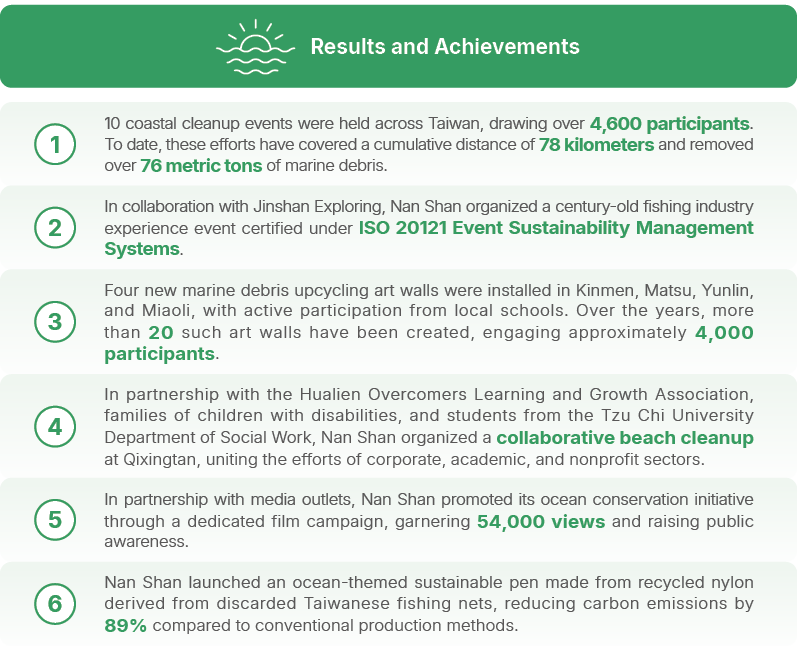
For 13 consecutive years, Nan Shan has carried out its Ocean Protection Action initiative to protect Taiwan’s coastline—from sand dune stabilization and coastal reforestation to nationwide beach cleanups—and expanded its focus to include marine debris and sustainable fisheries. By aligning corporate resources with multi-stakeholder cooperation and concrete action, the Company continues to defend marine ecosystems.
In 2024, Nan Shan invested approximately NT$4.8 million in initiatives aligned with concerns over declining fishery resources. For the first time, the Company introduced fish fry release activities, conducted at carefully evaluated times and locations to ensure ecological relevance. These efforts aim to heighten public awareness of fishery ecosystems. In addition, Nan Shan hosted local revitalization events that offered participants hands-on experiences with sustainable fishing practices, fostering a deeper understanding of how these methods coexist with nature. These programs also support coastal fishing communities whose livelihoods are affected by the depletion of marine resources.
In 2024, Nan Shan invested approximately NT$4.8 million in initiatives aligned with concerns over declining fishery resources. For the first time, the Company introduced fish fry release activities, conducted at carefully evaluated times and locations to ensure ecological relevance. These efforts aim to heighten public awareness of fishery ecosystems. In addition, Nan Shan hosted local revitalization events that offered participants hands-on experiences with sustainable fishing practices, fostering a deeper understanding of how these methods coexist with nature. These programs also support coastal fishing communities whose livelihoods are affected by the depletion of marine resources.