Energy and GHG Management
Greenhouse Gas Management
Since 2016, Nan Shan Life and NSGI have successively adopted the ISO 14064-1 standard for greenhouse gas (GHG) inventories, conducting regular assessments of carbon emissions generated from annual operations. In 2024, Nan Shan Life formally passed the specific emission reduction target as announced by the Science Based Targets Initiative (SBTi). To effectively control the main sources and patterns of carbon emissions, we established a carbon management team in the same year to actively develop reduction strategies and accelerate progress toward a low-carbon operation model. Emissions from Nan Shan’s operations are primarily attributed to purchased electricity. The Company achieved 100% inventory coverage for 2023 and 100% verification coverage for 2024.
Renewable Energy Use
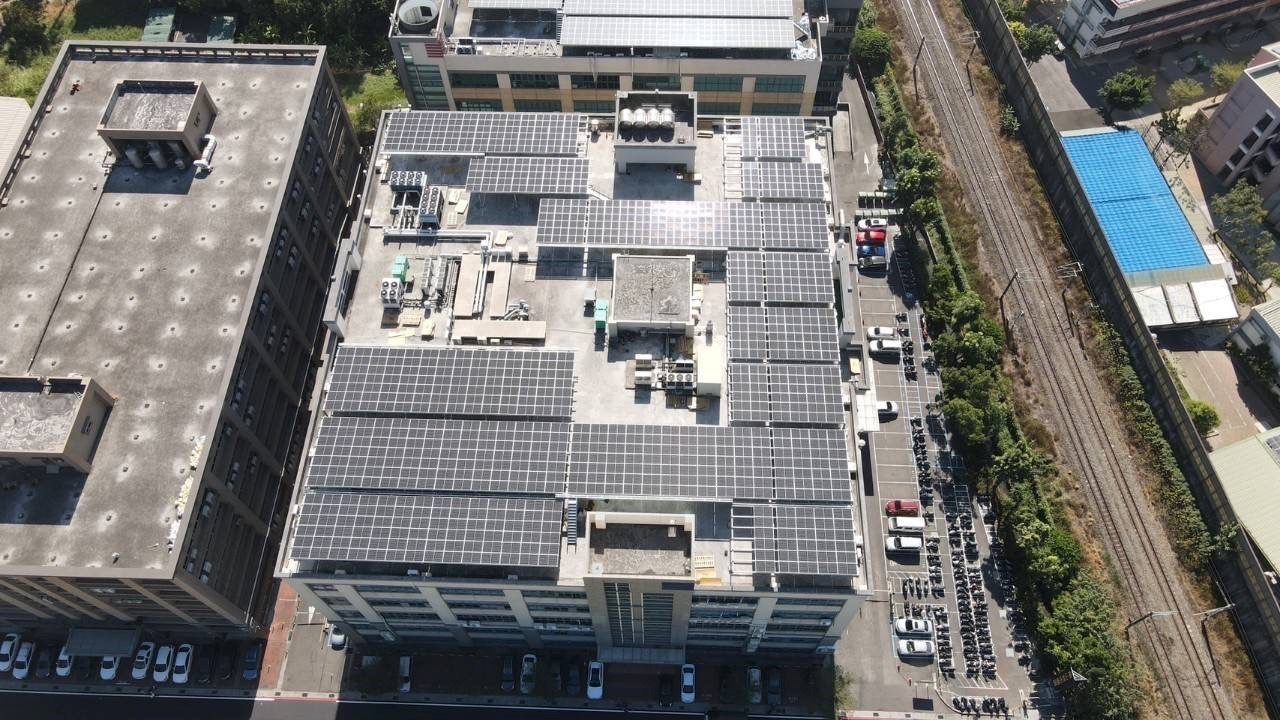
As the world pays increasing attention to environmental protection issues, Nan Shan Life makes green energy a key component of the power supply for the business operations. In 2024, 4.34 million kWh green electricity was purchased. To improve energy self-sufficiency, solar power generation systems were installed at the Nan Shan Education & Training Center, the office building in Tainan Science Park, and the warehouse in Neihu. The annual power generation is estimated to be 1.749 million kWh, accounting for about 4.7% of the Company’s electricity consumption.
Operational Carbon Reduction Initiatives
To advance its SBT-aligned carbon reduction targets and minimize its environmental footprint, Nan Shan Life and NSGI have established short-, mid-, and long-term goals for various environmental sustainability programs. These include office energy-saving measures, renewable energy development, employee energy-saving campaigns, and paperless policies and services, all aimed at reducing greenhouse gas emissions generated by core operations and fulfilling Nan Shan’s environmental protection commitment through tangible actions.
Equipment Energy-Saving Projects and Results
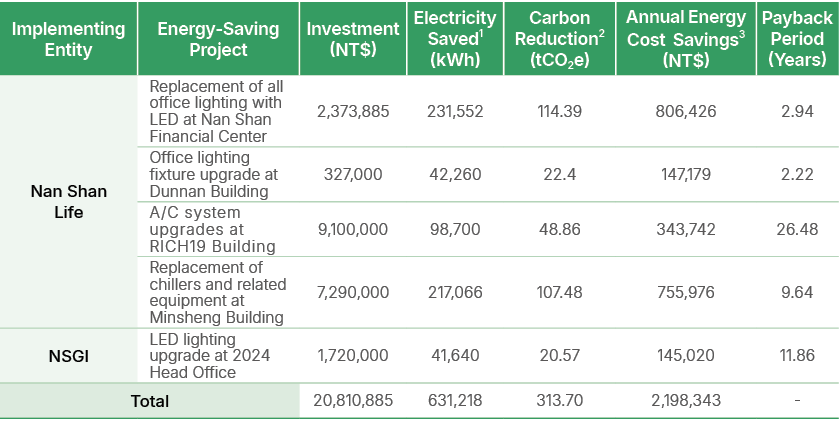
Note 1: Electricity savings = (Power difference between new and old equipment in watts) × 250 working days × 8 hours/day ÷ 1,000.
Note 2: Carbon reduction = Electricity saved × 2023 Taipower emission factor (0.494 kgCO₂e/kWh).
Note 3: Based on Taipower’s 2024 average rate of NT$3.4827/kWh × electricity saved.
Note 2: Carbon reduction = Electricity saved × 2023 Taipower emission factor (0.494 kgCO₂e/kWh).
Note 3: Based on Taipower’s 2024 average rate of NT$3.4827/kWh × electricity saved.
Green Investment Property Management
Green Building Certification
Nan Shan Life continues to incorporate green building standards in the development of future construction projects. In 2023, two investment property projects under development—Nan Shan A21 and A26—are both located in the Xinyi District of Taipei City. These projects were initially positioned as premium office buildings, and both are planned to obtain EEWH Gold, LEED Gold, and WELL Gold certifications.
Additionally, the Tamsui Shalun land lease project, which is mainly for self-use with a portion designated as investment property, is being developed in two zones: a cultural and creative area and a parking area. These zones are expected to receive EEWH Bronze and EEWH Silver certifications in 2026 and 2027, respectively.
Additionally, the Tamsui Shalun land lease project, which is mainly for self-use with a portion designated as investment property, is being developed in two zones: a cultural and creative area and a parking area. These zones are expected to receive EEWH Bronze and EEWH Silver certifications in 2026 and 2027, respectively.
Green Leasing 2.0
The electricity account for Taipei Nan Shan Plaza is registered under Nan Shan Life. As the building transitions to green power through third-party contracts, the cost structure and electricity billing will change, affecting leasing terms between the property owner and tenants. If tenants individually sign power purchase agreements (PPAs) with different electricity retailers, it would create challenges in allocating renewable energy due to varying procurement models.
To address this, Nan Shan Life consolidated the renewable electricity demand of multiple tenants, increasing bargaining power in green energy negotiations while resolving technical limitations of physical power transmission. This initiative substantially reduced barriers for tenants to access green energy, offering them more favorable prices and greater service flexibility.
In 2024, a total of approximately 969,000 kWh of renewable energy was supplied to tenants, enabling them to collectively obtain 969 Taiwan Renewable Energy Certificates (T-RECs), corresponding to a reduction of approximately 479 tCO₂e.
To address this, Nan Shan Life consolidated the renewable electricity demand of multiple tenants, increasing bargaining power in green energy negotiations while resolving technical limitations of physical power transmission. This initiative substantially reduced barriers for tenants to access green energy, offering them more favorable prices and greater service flexibility.
In 2024, a total of approximately 969,000 kWh of renewable energy was supplied to tenants, enabling them to collectively obtain 969 Taiwan Renewable Energy Certificates (T-RECs), corresponding to a reduction of approximately 479 tCO₂e.
Product Carbon Footprint Management
Nan Shan positions itself as a pioneer in low-carbon insurance by proactively reducing the carbon footprint of its operations and services. The Company also strives to develop insurance products that generate positive environmental spillover benefits, providing clients with eco-friendly solutions and driving the low-carbon transition across business operations, customer services, and product design.
Status of Progress on Product Carbon Footprint Initiatives
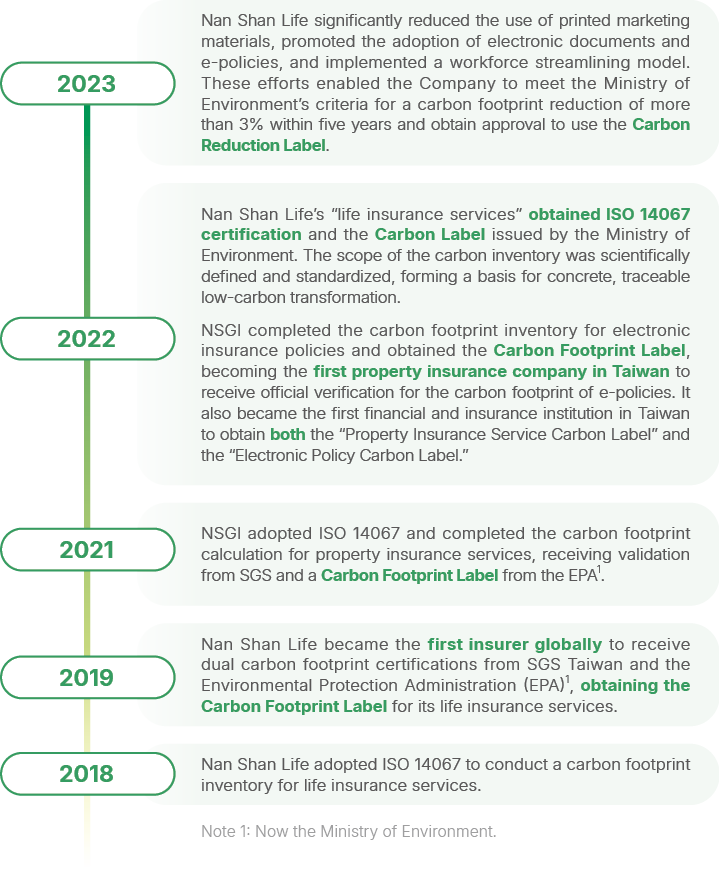
According to the latest carbon footprint inventory, the carbon footprint of Nan Shan Life’s “personal insurance services” has been reduced by more than 64.8% compared to the initial assessment conducted in 2019 (8.05 kgCO₂e per policy).
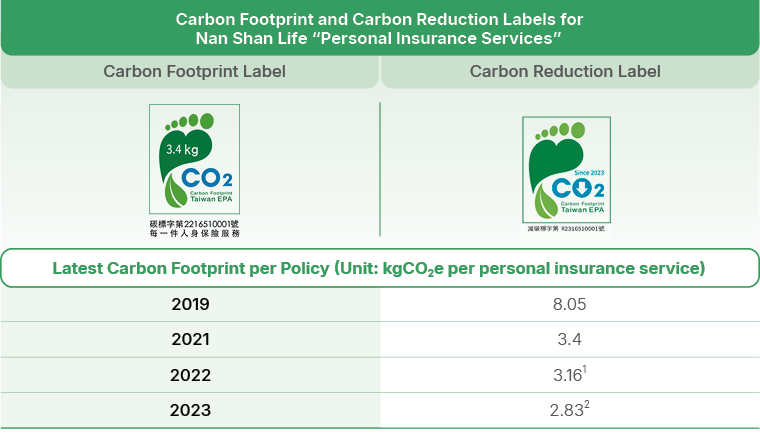
Note 1: In 2022, carbon emissions decreased by 5% compared to 2021, qualifying for the Carbon Reduction Label, valid until February 15, 2028.
Note 2: The 2023 data is based on internal inventory; the 2024 assessment was suspended due to regulatory amendments.
Note 2: The 2023 data is based on internal inventory; the 2024 assessment was suspended due to regulatory amendments.
Water Resource and Waste Management
Nan Shan Life continues to promote various waste reduction and water conservation initiatives, encouraging employees to practice environmentally responsible behavior in the workplace. The Company upholds the 3R principles—Reduce, Reuse, and Recycle—in its office waste sorting and recycling efforts, aiming to minimize its operational environmental footprint.
Water Resource Management
To further enhance water resource management, Nan Shan Life obtained ISO 46001 Water Efficiency Management Systems certification in December 2023, covering 57% of its operational footprint. The 2024 target was to reduce the per capita water consumption in self-owned buildings by 1% compared to 2023.
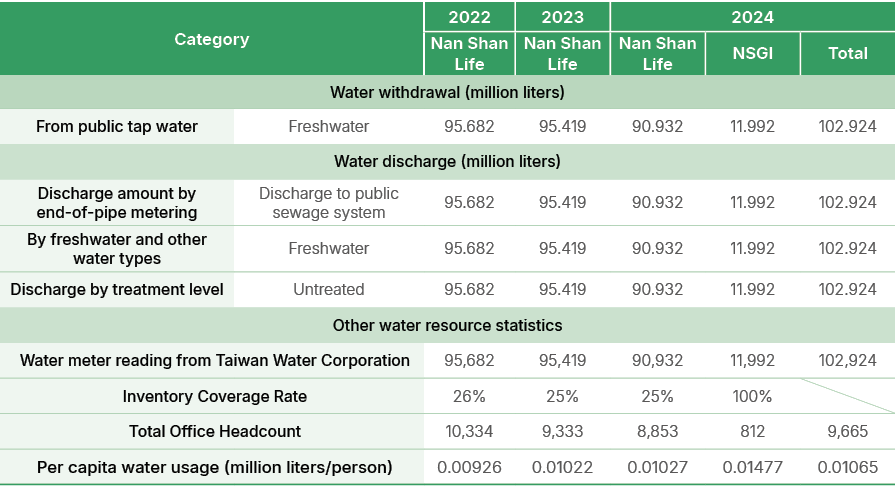
Note: Due to the nature of the financial and insurance industry, water withdrawal equals water discharge.
Waste Management
Measures adopted for managing office and domestic waste include:
• Printing and fax paper: The Company encourages the use of digital files and emails, centralized file storage on shared servers, paperless presentations, and double-sided printing. Reuse zones are designated for general documentation purposes. Color printing control: Daily use of color printing is regulated, with black-and-white and double-sided settings as the default. Overall, employees are encouraged to reduce paper use and maximize reuse to minimize both energy consumption and paper waste.
• For recycling efforts, 299.9 metric tons of waste paper and 70.9 metric tons of aluminum cans, PET bottles, plastics, and batteries were recycled in 2024. Nan Shan aims to reduce the per capita waste volume in self-owned buildings by 5% by 2030, using 2024 as the baseline year.
• Printing and fax paper: The Company encourages the use of digital files and emails, centralized file storage on shared servers, paperless presentations, and double-sided printing. Reuse zones are designated for general documentation purposes. Color printing control: Daily use of color printing is regulated, with black-and-white and double-sided settings as the default. Overall, employees are encouraged to reduce paper use and maximize reuse to minimize both energy consumption and paper waste.
• For recycling efforts, 299.9 metric tons of waste paper and 70.9 metric tons of aluminum cans, PET bottles, plastics, and batteries were recycled in 2024. Nan Shan aims to reduce the per capita waste volume in self-owned buildings by 5% by 2030, using 2024 as the baseline year.
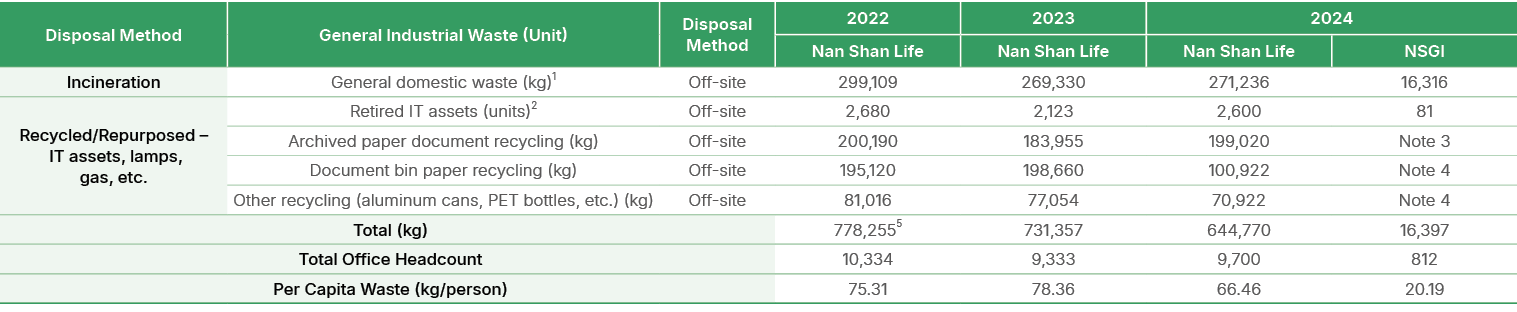
Note 1: General domestic waste and recycling include 13 self-owned buildings and 17 self-owned floors of Nan Shan Life, covering 26% of operational locations.
Note 2: Average weight per IT asset is calculated as 1 kg.
Note 3: Due to current building waste collection practices, this data is under review for future inclusion.
Note 4: Statistics will be available starting in 2025.
Note 2: Average weight per IT asset is calculated as 1 kg.
Note 3: Due to current building waste collection practices, this data is under review for future inclusion.
Note 4: Statistics will be available starting in 2025.
Sustainable Supply Chain Management
Nan Shan takes ethical management, environmental protection, and sustainable development as key supply chain management factors. We aim to leverage our influence and promote the concept of sustainability. We work with suppliers to fulfill corporate social responsibility and build a highly resilient supply chain to move toward a more sustainable and brighter future.
Supply Chain Management
Nan Shan Life adopts the ISO 20400 Sustainable Procurement Guidance, develops risk control methods through assessment of supplier sustainability risks and analysis of material sustainability issues, and revises sustainable procurement policies through education and training and revision of related documents to reduce the risks of the procurement process and implement the concept of sustainable procurement and supplier engagement.
Green Procurement
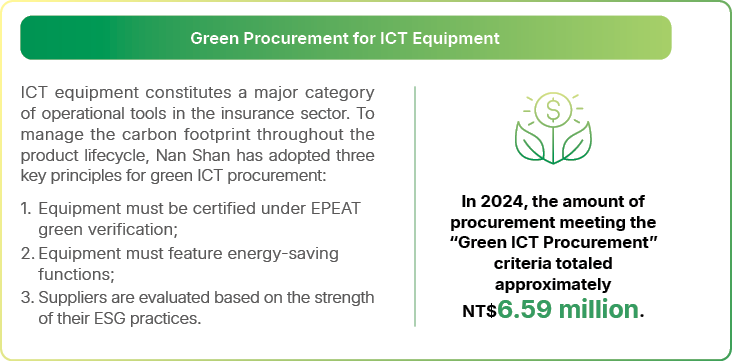
Nan Shan actively promotes green procurement, prioritizing environmentally friendly products. We believe that by sourcing low-carbon, energy-saving, recyclable, or environmentally certified products, we can reduce resource consumption and environmental impact while enhancing supply chain sustainability.
Green Procurement and Local Procurement Performance

Note 1: A supplier is considered “local” if its registered domicile is located within Taiwan.
Note 2: Green procurement items are defined in accordance with the Ministry of Environment’s “List of Designated Procurement Items.”
Note 2: Green procurement items are defined in accordance with the Ministry of Environment’s “List of Designated Procurement Items.”
Internal Carbon Pricing
In response to the era of carbon pricing, Nan Shan Life will implement an internal carbon pricing mechanism starting in 2025. By calculating implicit pricing, the company evaluates the cost-effectiveness of carbon reduction for procurement of "capital expenditure-based energy-saving equipment or self-built renewable energy facilities." This aligns with international trends, enhances identification, assessment, and management of carbon risks, fosters a corporate decarbonization culture, and estimates the financial and operational impacts of climate change risks.
The average carbon price is benchmarked against the cost-effectiveness of renewable energy procurement, with an implicit price of NT$5,061/tCO₂e calculated in 2024. The implicit carbon price for projects is calculated as follows:
The average carbon price is benchmarked against the cost-effectiveness of renewable energy procurement, with an implicit price of NT$5,061/tCO₂e calculated in 2024. The implicit carbon price for projects is calculated as follows:

