Climate-Related Risk Management and Response
Nan Shan follows “Taiwan‘s Pathway to Net-Zero Emissions in 2050” and aligns with the disclosure recommendations of the Financial Stability Board’s Task Force on Climate-related Financial Disclosures (TCFD). Nan Shan has established sound governance and strategic practices to manage climate-related issues, identify material climate risks and opportunities within operations, and set corresponding metrics and targets. Performance is tracked regularly to enhance organizational climate resilience.
Climate Governance
Board Oversight
The Board of Directors is the highest supervisory body for climate-related issues at Nan Shan Life. It is responsible for approving climate-related risk management policies and the climate risk appetite statement. Under the Board, the Risk Management Committee and the Corporate Sustainability Committee are tasked with regularly overseeing the implementation of climate-related risk and opportunity management, including the execution of relevant metrics and targets. Climate-related risks and opportunities are integrated into both operational and investment management frameworks. To ensure that directors have a clear understanding of climate risks and opportunities, the Company arranges climate-related education and training for Board members. In 2024, one hour of director training on climate topics was completed.
To effectively manage the potential impacts of future physical and transition risks, Nan Shan Life has established a Climate Risk Appetite Statement (CRAS) aligned with Taiwan‘s Pathway to Net- Zero Emissions in 2050 and the Company’s SBTi commitment. The Company will continue assessing the impact of these risks on both assets and liabilities to further strengthen its climate risk management capabilities. In addition, peer benchmarking on climate performance-linked mechanisms is used to promote climate governance and foster a sustainability-oriented corporate culture.
To effectively manage the potential impacts of future physical and transition risks, Nan Shan Life has established a Climate Risk Appetite Statement (CRAS) aligned with Taiwan‘s Pathway to Net- Zero Emissions in 2050 and the Company’s SBTi commitment. The Company will continue assessing the impact of these risks on both assets and liabilities to further strengthen its climate risk management capabilities. In addition, peer benchmarking on climate performance-linked mechanisms is used to promote climate governance and foster a sustainability-oriented corporate culture.
Senior Management
Under the supervision of the President, the Climate-Related Financial Disclosure Team (TCFD Team) and the Corporate ESG Execution Teams (under the Corporate Sustainability Committee) are designated to plan and implement the annual management of climate-related risks and opportunities. Each year, these teams identify potential risks and opportunities arising from climate change, assess the impact of climate risks on various business operations, and develop corresponding response measures. At least once per year, the Risk Management Department consolidates and reports the execution status of climate risk management by the TCFD Team to the President, the Risk Management Committee, and the Board of Directors. Similarly, the Sustainable Innovation and Development Department consolidates and reports the execution status of climate opportunity management by the Corporate ESG Execution Teams to the President, the Corporate Sustainability Committee, and the Board of Directors.
Climate Strategy
Identified Climate-Related Risks
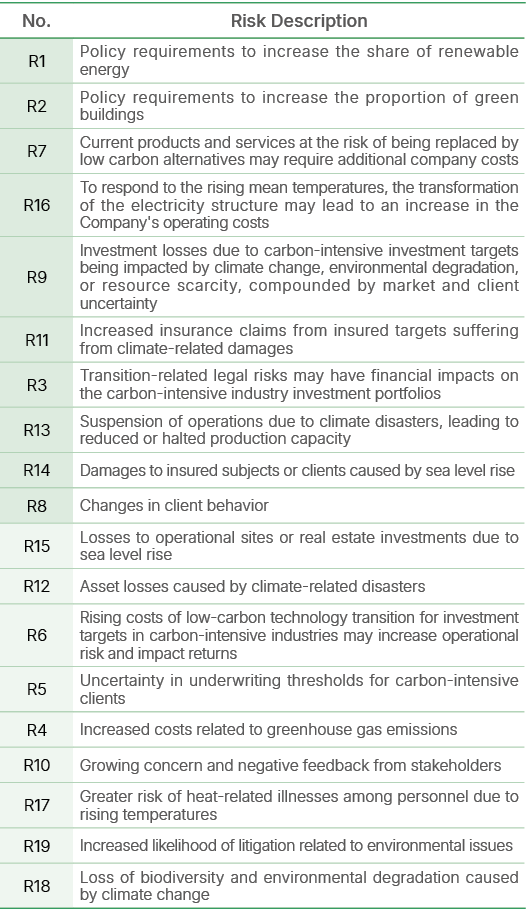
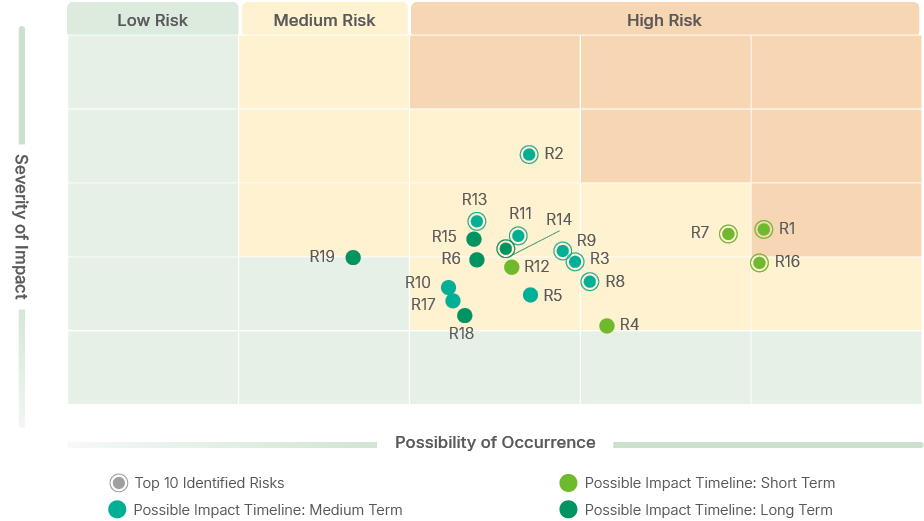
The TCFD team of the Company referenced domestic and international research reports’ climate related issues and taking into account the nature of its business, the Company identified and summarized 19 potential climate-related risks—including physical and transition risks, that the Company may face in the future. These risks were assessed based on their possibility of occurrence, degree of impact, and potential timeline (short, medium, and long term), followed by a materiality ranking. In 2024, the top ten most material climate-related risks were identified, comprising four physical risks and six transition risks. Corresponding mitigation measures were developed.
Climate-Related Risk Identification Items
Climate-Related Opportunities Identification Results
Following the completion of internal questionnaires and discussions by relevant departments, Nan Shan identified nine climate-related opportunities. A report was submitted to the Corporate Sustainability Committee and, upon approval, the Company selected eight key opportunity areas as strategic focal points. These serve as the foundation for developing detailed initiatives and action plans, enabling the Company to actively engage in climate action, stay ahead of market trends, and link sustainability efforts with business opportunities. The identification results are detailed in Section 3.1.1 of the 2024 Sustainability Report.
Climate Metrics and Targets
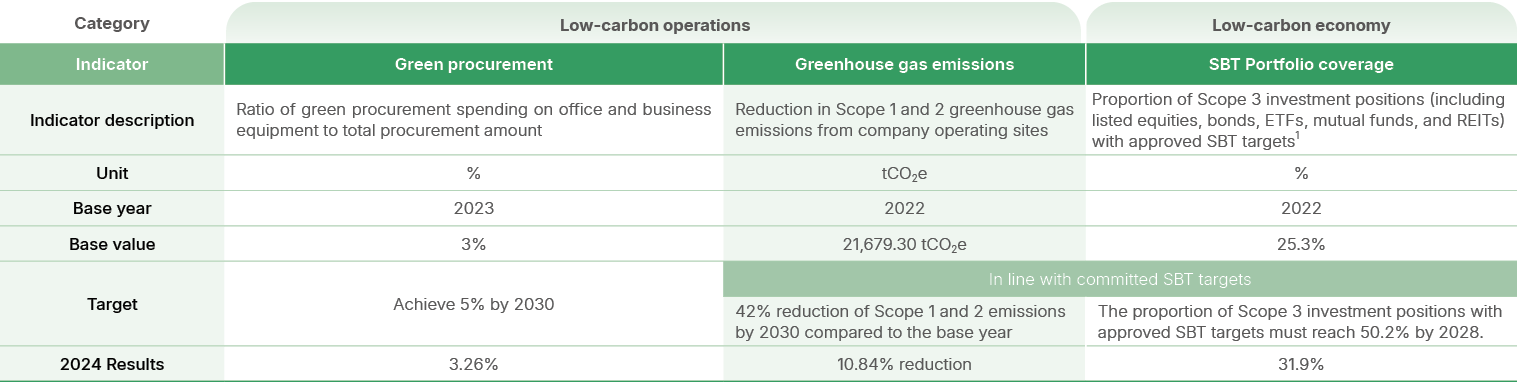
To monitor the management of climate-related risks, Nan Shan actively promotes the implementation of three major environmental sustainability systems across its self-owned and self-operated buildings: the ISO 14001 Environmental Management System, ISO 14064-1 Greenhouse Gas Inventory, and ISO 50001 Energy Management System. Through comprehensive inventories, the Company effectively monitors its operational carbon emissions and energy usage efficiency. In addition, Nan Shan signed the Science Based Targets Initiative (SBTi) commitment in 2023, completed the formulation of its emissions reduction targets, and officially obtained SBTi validation for its science-based targets in August 2024.
Note : According to the SBTi methodology, Nan Shan adopts the Portfolio Coverage (PC) approach for to set Scope 3 targets across its investment positions.
SBT Carbon Reduction Pathway and Performance for the Year
Nan Shan has put its carbon reduction commitment into practice by signing the SBTi commitment in 2023 and completing target validation in 2024. Using 2022 as the base year, the Company has pledged to reduce Scope 1 and 2 emissions by 42% by 2030 and to ensure that 50.2% of its investment portfolio meets SBT targets by 2028.
Scope 1 and 2 Emissions
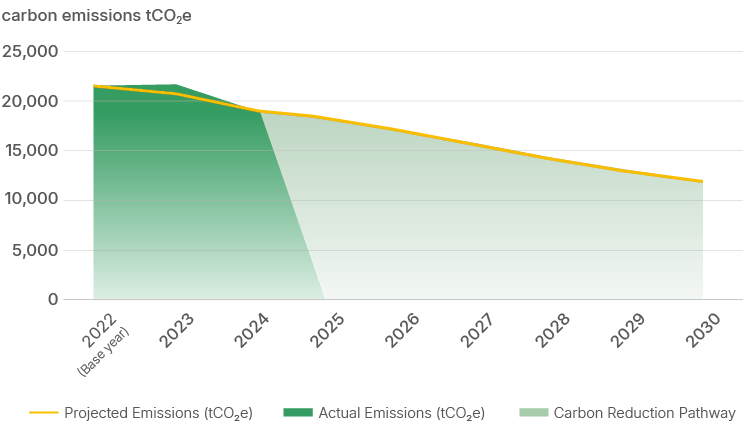
To actively achieve the SBT carbon reduction targets, Nan Shan has implemented an energy transition roadmap to achieve a 42% reduction by 2030. This includes installing solar photovoltaic systems on owned and newly constructed buildings, purchasing green electricity, and implementing energy-saving measures. Through these dual strategies, the Company is increasing its use of renewable energy and maximizing emission reduction effectiveness, thus advancing corporate energy transition. In 2024, Nan Shan’s total Scope 1 and 2 emissions amounted to 19,328.79 tCO₂e, representing a 10.84% reduction compared to the base year, achieving its annual carbon reduction goal.
Nan Shan’s SBT Carbon Reduction Pathway (Scope 1 and 2)

Scope 3 Emissions (Investment Portfolio)
For financial and insurance companies, the majority of carbon emissions come from Scope 3 investment activities. In 2023, Nan Shan Life incorporated climate-related risk management mechanisms into its “Investment Policy Guidelines” and took concrete actions to support netzero emissions, including the establishment of investment rules for carbon-intensive industries and enhancement of mechanisms for exercising shareholder activism. This enabled the Company to better assess the potential risks and opportunities posed by climate change when making investment decisions. In the meantime, Nan Shan Life continued to exert its financial influence as a professional institutional investor by engaging with or advocating to counterparties and intermediaries about the importance of the SBT-based carbon reduction. The Company has also set the SBTi target for its investment portfolio:

Note : Include listed equities, bonds, ETFs, mutual funds, and real estate investment trusts (REITs).
As of 2024, the SBTi Target Set coverage of Nan Shan Life’s investment positions has reached 31.9%, calculated using the book value. Through active advocacy and proactive engagement with investee companies, Nan Shan Life continues to make steady progress toward its 2028 target.
